
The rise of the luxury four-wheel drive
- Written by: Men.com.au
What happened to Australia's big SUVs?
There was a time when a large four-wheel drive was simply a practical vehicle.
Farmers bought them. Tradies drove them. Families towing caravans relied on them. Remote communities depended on them.
Today, many of Australia's most capable four-wheel drives have become luxury purchases.
Government taxes, fuel-efficiency regulations and rising manufacturing costs have steadily pushed prices higher. The result is that vehicles once regarded as hardworking tools are increasingly being viewed as premium products.
Australia's Luxury Car Tax applies to vehicles above specific thresholds and adds significant cost to many large SUVs. At the same time, the Federal Government's New Vehicle Efficiency Standard is encouraging manufacturers to increase the number of low-emission and electric vehicles sold in Australia. While the government argues the policy is not a tax, the practical effect is to place greater pressure on manufacturers selling larger, heavier and less fuel-efficient vehicles.
For buyers, that often translates into fewer model choices and higher prices.
Large SUVs such as the Toyota LandCruiser, Nissan Patrol and some premium European off-road vehicles now occupy a market segment that increasingly overlaps with luxury vehicles rather than mainstream family transport.
Yet demand remains remarkably strong.
Australians continue to buy large four-wheel drives because there are few genuine alternatives when towing heavy caravans, crossing remote regions or travelling long distances with family and equipment.
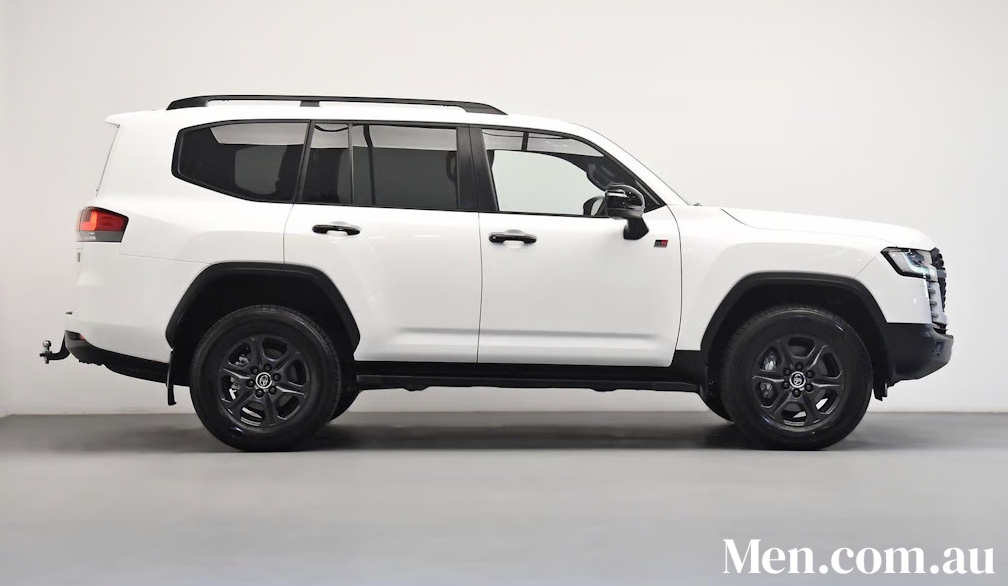
Few vehicles illustrate this better than the Toyota LandCruiser 300 Series GR Sport.
The GR Sport represents the flagship performance-oriented version of Toyota's legendary LandCruiser.
Powered by Toyota's 3.3-litre twin-turbo V6 diesel engine, the GR Sport produces approximately 227kW of power and 700Nm of torque. The vehicle combines serious off-road capability with modern luxury and technology.
Features include:
• Front and rear differential locks
• Crawl Control off-road assistance
• Multi-Terrain Select drive modes
• Advanced suspension tuning
• Premium leather-accented interior
• Large infotainment display
• Comprehensive Toyota Safety Sense technology package
• 3.5-tonne towing capacity
The result is a vehicle equally comfortable towing a large caravan across Australia, crossing rough outback tracks or arriving at a business meeting in the city.
The catch is the price.
Depending on options and on-road costs, a new LandCruiser GR Sport can approach or exceed $150,000 drive-away in some parts of Australia. What was once considered a practical workhorse has become a significant financial commitment for many households.
That price reflects more than inflation.
Modern buyers expect sophisticated safety systems, advanced technology, premium interiors and improved performance. Governments are also demanding lower emissions from manufacturers, creating additional pressure across the industry. Luxury Car Tax thresholds for 2025-26 remain at $80,567 for most vehicles and $91,387 for fuel-efficient vehicles, ensuring many large SUVs continue to attract additional taxation.
Yet despite the cost, the LandCruiser remains one of Australia's most respected vehicles.
Its reputation has been built over decades in some of the harshest environments on earth. It is trusted by farmers, mining companies, emergency services, adventurers and families alike.
The modern LandCruiser may now sit comfortably in luxury vehicle territory, but at its heart it remains something increasingly rare in the automotive world: a vehicle designed to go almost anywhere and bring you home again.
As Australia moves towards a more electric future, the question is whether vehicles like the LandCruiser become less common, more expensive and ultimately even more desirable.
If current trends continue, the age of the affordable big four-wheel drive may already be behind us.