

What Actually Causes a Cockroach Infestation? (It's Not Just a Dirty Kitchen)
TL;DR: cockroaches move in when a home gives them water, warmth and a dark gap to hide in. Food matters, but it is the smallest part of the picture. That is why a spotless kitchen can still end up with roaches.
If you have been wondering what causes cockroach infestation in a clean house, the problem is usually the building, not the cleaning.
What causes a cockroach infestation?
Four things, ranked by how much they matter:
-
Water. Roaches can last weeks without food but only days without moisture.
-
Warmth. Fridge motors, dishwashers, roof spaces, wall cavities.
-
Hiding spots. Tight, dark gaps where they can wedge in and stay undisturbed.
-
Food. Crumbs, pet food, bin residue, grease behind the oven, cardboard.
One cockroach in the hallway is a visitor. An infestation is what happens when that cockroach finds all four.
Why water matters more than crumbs
Most homes leak somewhere and the owner has no idea. Fix the water and the population loses its reason to grow.
|
Where the water comes from |
Why roaches like it |
Quick check |
|
Slow leak under the sink |
Constant water in a dark cupboard |
Press the cupboard base for soft spots |
|
Dishwasher or washing machine |
Warm, damp, never disturbed |
Pull the appliance out once a year |
|
Air conditioner drain line |
A steady drip somewhere hidden |
Follow the pipe to where it ends |
|
Blocked gutters and downpipes |
Damp walls and subfloor |
Clear before storm season |
|
Bathroom with a dead exhaust fan |
Humid air with nowhere to go |
Run the fan 20 minutes after a shower |
|
Closed-off subfloor vents |
Cool, damp, completely private |
Check garden beds are not blocking vents |
Which cockroach are you dealing with?
This changes everything about how you treat it.
|
Species |
Usually found |
Gets in by |
Difficulty |
|
German |
Kitchens, appliances, unit blocks |
Boxes, groceries, used appliances |
Hard |
|
American |
Drains, roof voids, grease traps |
Pipes and drains |
Moderate |
|
Australian |
Gardens, mulch, subfloors |
Flying or walking in |
Moderate |
|
Smokybrown |
Roof cavities, palms |
Drawn to lights, enters roofline |
Moderate |
|
Brownbanded |
Bedrooms, wardrobes, electronics |
Second-hand furniture |
Hard |
The important split: German and brown-banded roaches breed indoors, so numbers climb fast and quietly. The rest live outside and come in for a drink, which means the fix is at the perimeter and the drains, not the kitchen bench.
How do they get in?
Not by chewing through walls. They hitch a ride or find a gap.
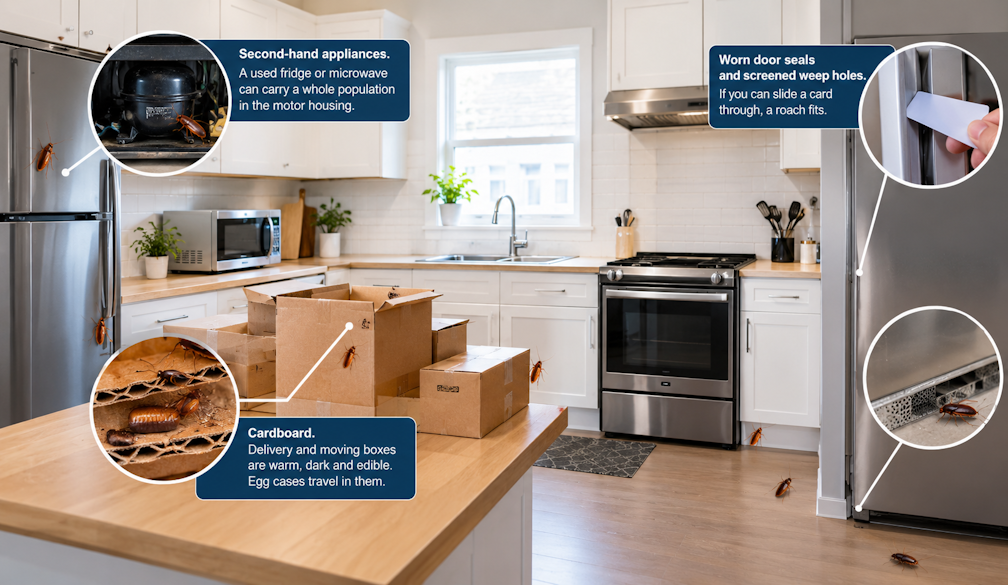
- Cardboard. Delivery and moving boxes are warm, dark and edible. Egg cases travel in them.
- Second-hand appliances. A used fridge or microwave can carry a whole population in the motor housing.
- Pipe gaps. The hole where a pipe passes through a cabinet base is often finger-width and wide open.
- Drains and overflow pipes. The main route for American cockroaches in older homes.
- Worn door seals and screened weep holes. If you can slide a card through, a roach fits.
- The garden. Deep mulch against the wall, palms, stacked timber, bins parked by the back door.
Why your neighbour's kitchen can become your problem
In units, townhouses and duplexes, plumbing risers and shared wall cavities work like roads. A German cockroach population in one unit spreads to the units above and below by following the warm pipes.
So a tenant who never leaves a dish in the sink can still find roaches in the dishwasher seal. If treatment keeps working for a fortnight and then fails, the conversation needs to include the body corporate.
Does the humid coast make it worse?
Yes. Warm, sticky summers and heavy storms are close to perfect conditions for every species above. Timber homes on stumps and older beach cottages hold damp in the subfloor and roof void for weeks after a wet spell. Add a holiday let with gaps between guests and rubbish sitting in the bin, and a small population gets months to grow.
The pattern runs the length of the subtropical coast, from the Northern Rivers up through South East Queensland. Technicians at SWAT Pest Control Brisbane see the same cycle every year: calls climb through the first humid stretch of summer, then again after a run of storms.
How a few roaches becomes an infestation
Egg cases are the reason. A female German cockroach carries a case holding 30 to 40 eggs, and she produces several in her life. The shell is hard enough that most surface sprays do nothing to it.
You can kill every roach you can see and still have hundreds of eggs hatching a fortnight later somewhere you never sprayed.
Signs the population is settled in, not passing through:
- Roaches out in daylight, which usually means the hiding spot is overcrowded
- Dark specks like ground pepper along skirting boards and inside cupboards
- A musty, oily smell behind an appliance or in a cupboard
- Shed skins or empty egg cases in drawer runners and hinges
- Sightings in more than one room
Why supermarket spray often backfires
Most retail aerosols repel. They kill what they touch and push the survivors somewhere else, which in a unit means deeper into the wall or straight next door. You get a quiet fortnight, then a comeback that is harder to find.
What works instead:
-
Repair the moisture source first.
-
Seal the gaps around pipes and doors.
-
Get the cardboard out of the house.
-
Treat the hiding places, not the open floor, using non-repellent gel bait that roaches carry home.
-
Add a growth regulator so the next generation never reaches breeding age.
Renting or managing a holiday let?
For tenants, timing matters as much as treatment. Pest control is a common sticking point at the final inspection, especially where pets have been in the property, so a documented treatment beforehand is far cheaper than a bond dispute. Most tenants book end of lease pest control before the final inspection rather than after the argument starts.
Landlords have the opposite problem. Empty weeks are exactly when small populations grow unnoticed, so one treatment booked ahead of summer usually beats reactive call-outs in peak season.
So what really causes a cockroach infestation?
Not a dirty kitchen, in most cases. Roaches move in because the house offers water, warmth and a dark gap, and they stay because the egg cases survive whatever you spray at the adults.
Which means the fix is a repair job more than a cleaning job. Find the leak, close the gaps, get rid of the cardboard, then treat the hiding places rather than the floor.
FAQs about what causes a cockroach infestation
What causes cockroaches in a clean house?
Water and hiding places. A leak under the sink, a damp subfloor or an air conditioner drain gives roaches what they need. Food makes the problem grow faster but is rarely the reason it started.
Does one cockroach mean an infestation?
Not always. One large roach is often an outdoor species after a drink. Several small light-brown ones in a kitchen, or any sighting in daylight, point to a population already living indoors.
Can cockroaches get in through the drains?
Yes, and it is the main route for American cockroaches. They travel through sewer and stormwater pipes and come up through floor wastes, overflows and dry traps.
What attracts cockroaches into a house at night?
Moisture first, then warmth and light. A dripping tap, a damp bathroom or a bin by the back door will pull roaches in from the garden long before crumbs do.
Why do cockroaches keep coming back?
Because the cause was never removed. The leak is still there, the hiding places were never treated, or they are walking back in from a neighbouring unit through a shared wall or pipe.
 "Pin It")